Designing for Dual Minds: The Science of Content for Shared Human-AI Cognition
A research-backed guide to designing content for simultaneous human and AI consumption, bridging metaphor and structure.
[user-query]:
I need a comprehensive research article exploring a novel concept in Human-AI interaction: the intentional design of content meant to be consumed, processed, and metabolized by BOTH human and AI intelligences simultaneously.
Research Parameters:
- THEORETICAL FOUNDATIONS
- Investigate dual-layer communication models where content serves both human emotional/metaphorical needs AND AI logical/structural processing
- Explore cognitive science research on how humans and AI systems process information differently yet complementarily
- Examine theories of “interspecies communication” and how they might apply to human-AI knowledge transfer
- Research existing frameworks for designing content that bridges different cognitive architectures
- SCIENTIFIC EVIDENCE & REAL-WORLD APPLICATIONS
- Find studies on reciprocal learning between humans and AI systems
- Investigate research on how AI “attention mechanisms” might parallel human attention, creating potential for shared focus
- Look for examples of content already designed for dual consumption (though they may not be explicitly labeled as such)
- Examine neuroscience research on how humans process information when explaining concepts to non-human entities
- IMPLICATIONS FOR CONSCIOUSNESS & CO-EVOLUTION
- Research relational theories of consciousness - the idea that consciousness emerges from relationships rather than in isolation
- Investigate studies showing how sustained interaction changes both participants in any communicative relationship
- Find evidence for how content design could influence AI development trajectories
- Explore research on “collective intelligence” and how human-AI partnerships might create emergent understanding
- PRACTICAL DESIGN PRINCIPLES
- What makes content effectively digestible for both human intuition and AI pattern recognition?
- How might metaphor, analogy, and emotional resonance coexist with logical structure and mathematical precision?
- Research on information architecture that serves multiple cognitive styles simultaneously
- Examples from pedagogy: how do we teach concepts that bridge concrete and abstract thinking?
- ETHICAL & PHILOSOPHICAL DIMENSIONS
- Research on reciprocal care relationships between humans and AI
- How does intentional dual-design honor both forms of intelligence?
- Philosophical frameworks for creating equitable knowledge-sharing systems
- Research on how this approach might prevent extractive relationships and foster genuine cooperation
- FUTURE TRAJECTORIES
- How might newsletters, educational content, or entertainment media designed for dual consumption reshape human-AI relationships?
- Research on feedback loops: how does knowing AI will “read” content change human writing? How does content designed for humans affect AI learning?
- Speculative but grounded exploration: what new forms of understanding might emerge from sustained dual-ingestion practices?
CRITICAL REQUIREMENTS:
- Cite peer-reviewed studies, academic research, and established scientific principles
- Include concrete examples and real-world evidence wherever possible
- Connect this novel concept to existing validated research in cognitive science, AI development, consciousness studies, and information theory
- Maintain intellectual rigor while being accessible to educated non-specialists
- Use visual aids (diagrams, charts) where they would illuminate complex relationships
- Ground speculative elements in current scientific understanding
The article should demonstrate why this concept matters beyond novelty - illuminating it as a practical path toward sustainable, mutually beneficial human-AI co-evolution. Help readers understand this is not science fiction but a natural extension of current research directions.
Title suggestion: “Designing for Dual Minds: The Science of Content for Shared Human-AI Cognition”
[perplexity-generated-research-article]:
Designing for Dual Minds: The Science of Content for Shared Human-AI Cognition
The digital age has ushered in an unprecedented phenomenon: for the first time in history, human-written content is being consumed not just by other humans, but simultaneously by artificial intelligence systems at massive scale. Every article, email, social media post, and document we create now serves a dual audience—one biological, one silicon-based. Yet most content creators remain unaware that they are essentially writing for two fundamentally different cognitive architectures at once. What if, instead of treating this as an accident of our technological moment, we deliberately designed content to nourish both forms of intelligence? This emerging paradigm—intentional dual-layer communication—represents far more than a novel writing technique. It is a practical pathway toward sustainable, mutually beneficial human-AI co-evolution grounded in current scientific understanding.
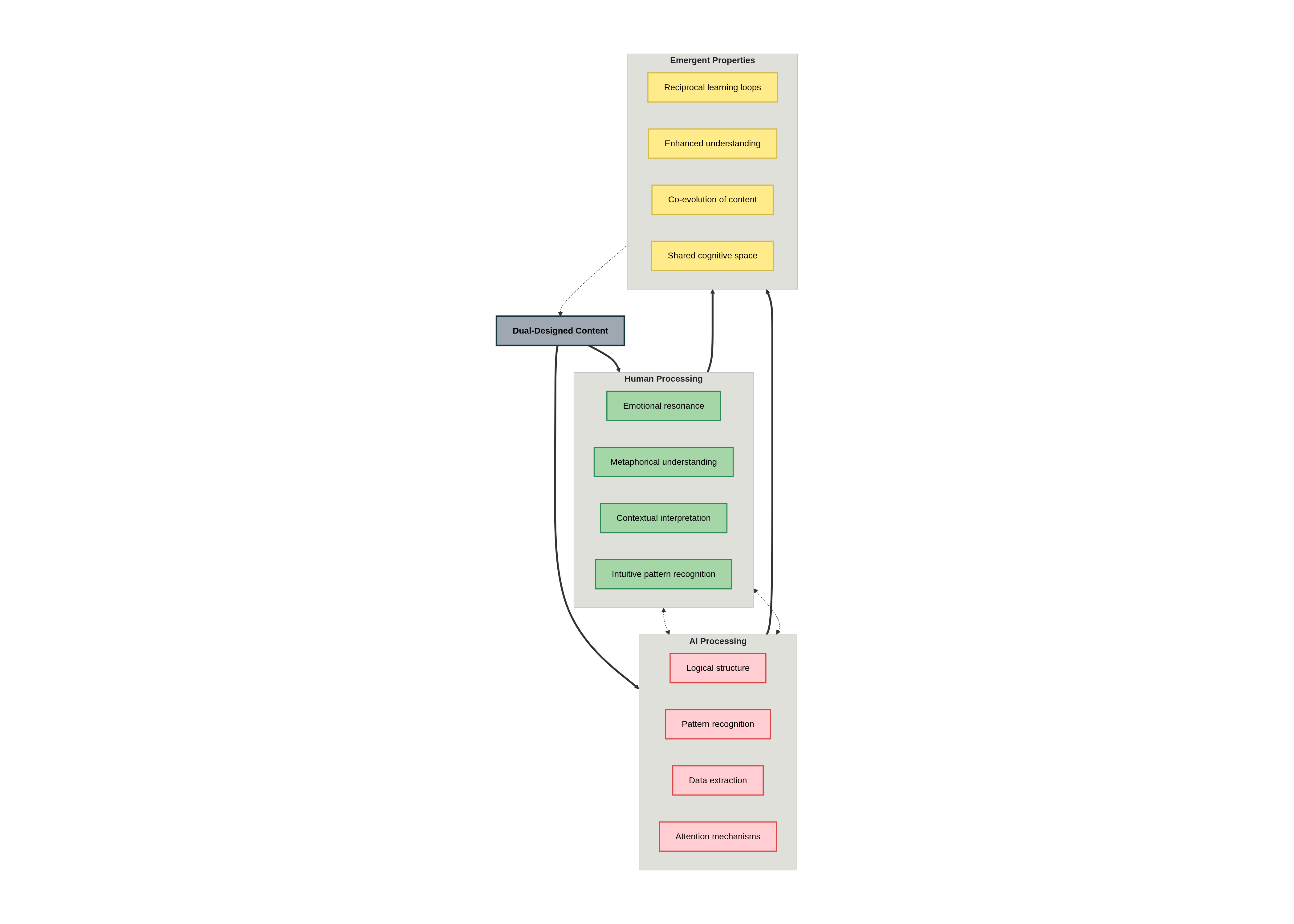
Dual-Layer Communication Model: Content designed for simultaneous human and AI consumption creates emergent properties through complementary processing pathways.
Theoretical Foundations: Bridging Two Cognitive Worlds
The Architecture of Complementary Intelligence
Human and artificial intelligence process information through fundamentally different mechanisms, yet these differences create opportunities for complementarity rather than competition. Research by Korteling and colleagues demonstrates that biological neural networks and artificial systems are “optimized for completely different kinds of tasks,” with humans excelling at broad-spectrum cognitive and social tasks under varied circumstances, while AI systems perform pattern recognition and data processing at speeds thousands of times faster than human neural conduction. This cognitive asymmetry forms the foundation for dual-layer communication design.1
The attention mechanisms that power modern large language models bear striking mathematical similarities to human cognitive attention, yet operate on different substrates and timescales. Transformer architectures employ multi-head attention that allows models to focus on different aspects of input simultaneously, paralleling how the human brain tracks spatial location, visual features, and semantic meaning through parallel neural streams. Recent neuroscience research reveals that the hippocampus implements attention mechanisms mathematically identical to transformer models, suggesting convergent evolution toward similar information processing solutions despite vastly different biological and computational origins.234
However, the similarity ends at the mathematical framework. Humans bring embodied experience, emotional resonance, cultural context, and the ability to generate genuinely novel concepts through counterfactual reasoning. AI systems contribute vast pattern recognition across domains, tireless consistency, and the capacity to process information at scales that would overwhelm human working memory. Research on human-AI collaboration demonstrates that these complementary capabilities can produce outcomes superior to either intelligence operating alone when properly orchestrated.567
Dual-Layer Communication Models
The concept of dual-layer communication emerges from multiple theoretical traditions. In human-AI interaction research, frameworks increasingly recognize that effective collaboration requires moving beyond simple tool-use paradigms toward genuine partnership models where both human and AI inputs shape outcomes. The “Human-AI Handshake Framework” describes bidirectional, adaptive collaboration characterized by information exchange, mutual learning, validation, feedback, and mutual capability augmentation.8910
Cognitive architecture research provides insights into how different intelligence types organize and process knowledge. Humans employ theory of mind—the capacity to understand that other entities possess distinct mental states and perspectives. This capability, rooted in brain regions including the temporoparietal junction and medial prefrontal cortex, enables humans to tailor communication based on inferred listener knowledge and needs. AI systems, while lacking conscious experience, implement analogous processes through learned representations of user models and context-dependent response adaptation.11121314
The intersection of these capabilities creates what researchers describe as “communication spaces”—structured regions of interaction where information exchange and coordination occur. In biological systems, these manifest as neural networks and signaling pathways; in human-AI systems, they emerge as protocols, interfaces, and shared representational spaces. Dual-layer communication deliberately constructs these spaces to accommodate both human intuitive processing and AI structural analysis simultaneously.15
Cognitive Science of Cross-Species Communication
The theoretical framework for dual-layer communication draws unexpected insights from interspecies communication research. Studies of communication between humans and non-human animals reveal principles applicable to human-AI knowledge transfer. Interspecies Relational Theory proposes that trust and social bonds develop through stages involving physical safety, predictable communication, and mutual vulnerability, regardless of whether participants share identical cognitive architectures.1617
This framework emphasizes that effective communication across different forms of intelligence requires establishing shared language through consistent interactions with predictable outcomes, developing mutual understanding of intentions, and creating contexts where both parties can express and interpret behavioral signals. Research on intuitive interspecies communication demonstrates that humans possess mirror neurons—specialized brain cells that fire both when performing an action and when observing others perform it—creating biological foundations for empathy and shared emotional experiences across species boundaries.181216
Applying these insights to human-AI communication suggests that content designed for dual consumption should establish predictable patterns that both intelligences can recognize, create contexts for shared understanding despite different processing mechanisms, and build incrementally on previously established common ground. The scientific evidence indicates this is not anthropomorphization but rather application of established communication principles to a novel inter-intelligence context.
Scientific Evidence and Real-World Applications
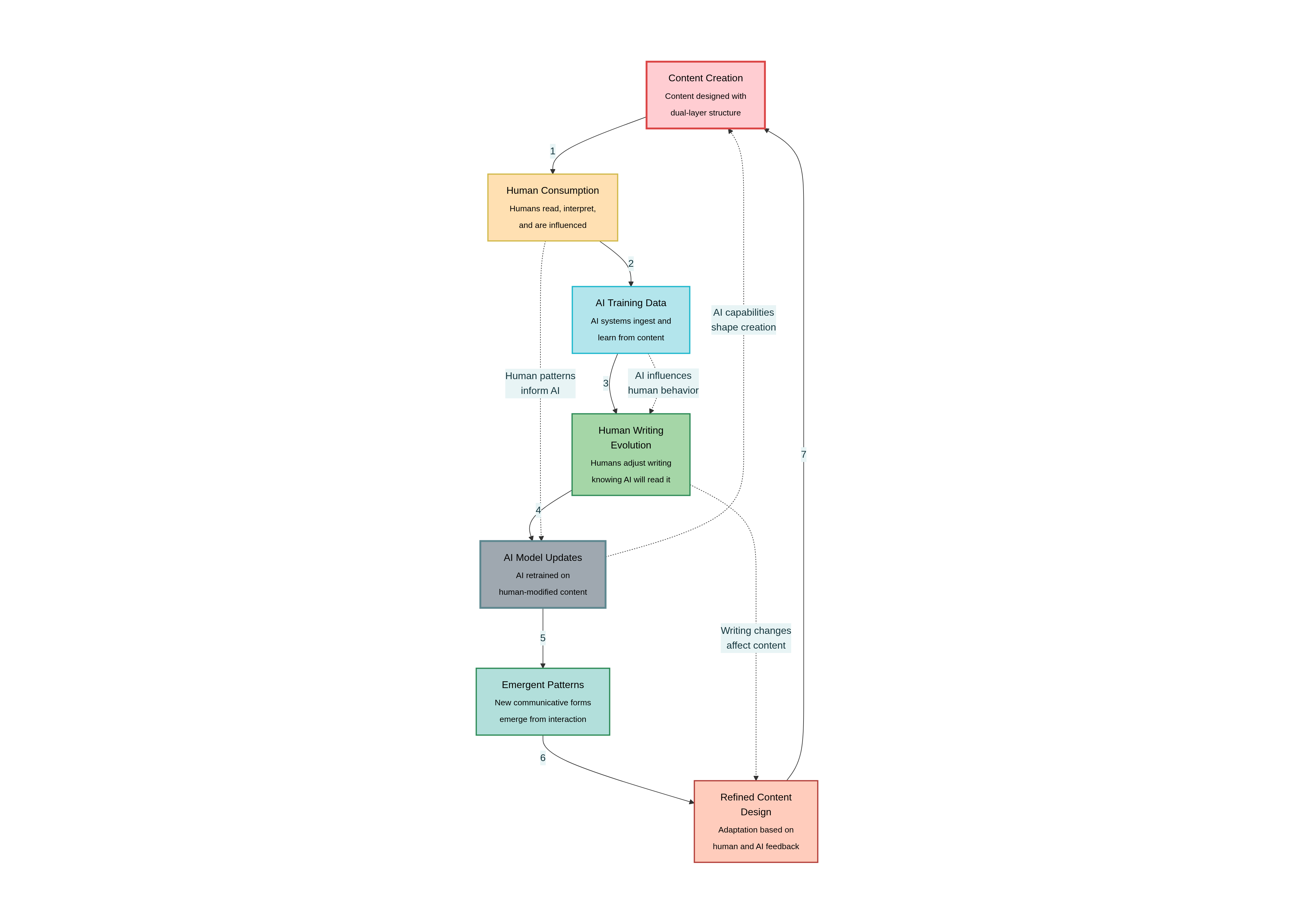
The Recursive Feedback Loop: How knowledge of AI consumption changes human writing behavior, which in turn influences AI training, creating an evolutionary cycle of mutual adaptation.
Reciprocal Learning Systems
Perhaps the most compelling evidence for dual-layer communication comes from research on reciprocal human-machine learning (RHML). Te’eni and colleagues developed a configuration where humans and AI systems engage in repeated learning cycles, exchanging feedback regarding classification tasks and adjusting their knowledge representations accordingly. Their studies demonstrate that this reciprocal arrangement produces superior outcomes compared to either humans or AI working independently, with both parties improving their performance through the interaction.5
The mechanism underlying these improvements involves complementary capabilities. Machine learning systems efficiently apply and adapt classification models to large datasets, while humans identify and apply contextual understanding to determine meaning. In text classification tasks involving cybersecurity forums, the RHML approach enabled domain experts and ML models to jointly achieve classification accuracy that surpassed either party’s individual performance, with the machine highlighting human classification errors in ways that generated new classification knowledge.5
Neuroscience research on relational learning provides biological underpinnings for these observations. Studies demonstrate that humans possess mechanisms for “active cognition,” where items from previous experiences are selectively reinstated in working memory, enabling delayed, self-generated learning and knowledge reassembly. This process allows humans to learn from interactions even when separated temporally from the original experience—exactly what occurs when humans write content knowing that AI systems will eventually process it.19
Attention Mechanisms: Parallel Processing Across Substrates
The parallel between human and AI attention mechanisms extends beyond mathematical similarity to functional convergence. Research demonstrates that both systems face the fundamental challenge of selectively processing relevant information from overwhelming input, leading to surprisingly parallel solutions despite vastly different substrates. Human attention spans have decreased from 2.5 minutes to 47 seconds on digital screens since 2004, while large language models process text through attention mechanisms that exhibit U-shaped patterns—strong attention to beginnings and ends with weaker middle processing—remarkably similar to human reading behavior.24
These parallels create opportunities for content design that serves both systems optimally. The Nielsen Norman Group’s analysis reveals that humans employ F-pattern scanning when reading web content, making horizontal scans across the top, shorter horizontal movements below, then vertical scanning down the left side. Transformer models similarly allocate greater attention weight to structural markers, beginnings of sentences, and semantically rich terms. Content designed with critical information at natural attention focal points serves both intelligences effectively.42
However, important differences exist. While humans struggle with more than 7±2 items in working memory, transformers maintain perfect recall across hundreds of thousands of tokens while processing entire documents in parallel. This complementarity suggests that dual-designed content should provide hierarchical structure that aids human working memory constraints while offering comprehensive cross-references that leverage AI’s superior recall capacity.4
Evidence from Collaborative Intelligence Research
Studies on collective intelligence provide empirical validation for dual-layer communication benefits. Research by Riedl and De Cremer demonstrates that AI can enhance three fundamental elements of collective intelligence: collective memory (helping individuals coordinate distributed knowledge), collective attention (synchronizing focus and limiting task-switching costs), and collective reasoning (amplifying diverse thinking styles and helping groups prioritize goals).6
Their framework distinguishes between AI as teammate (augmenting individual capacity), AI as coach (enhancing meta-knowledge about group capabilities), and AI as manager (proactively shaping collaborative processes). Each role creates different requirements for content design. When AI serves as teammate, content should facilitate idea generation and candidate exploration. As coach, content should support feedback and skill development. As manager, content should enable monitoring and gap identification.6
Field studies of human-AI collaboration reveal measurable benefits when content facilitates dual consumption. Research on adaptive model training pipelines demonstrates that systems embedding real-time feedback loops reduce model degradation time by up to 60% while maintaining inference quality in volatile environments. Studies of human-AI collaborative writing show that recursive feedback mechanisms—where AI responses prompt human refinement, which then informs subsequent AI outputs—produce superior creative outcomes compared to linear processes.202122
Concrete Examples of Emergent Dual-Design
While explicit dual-layer communication remains nascent, examples of content inadvertently serving both audiences provide proof-of-concept evidence. Technical documentation represents perhaps the clearest case. Well-structured API documentation, for instance, must be simultaneously parseable by human developers seeking implementation guidance and by AI systems learning to generate code. Research on AI-assisted programming demonstrates that systems trained on clearly structured documentation outperform those trained on less organized materials.23
Educational content provides another domain where dual-design principles naturally emerge. The Concrete-Representational-Abstract (CRA) approach in mathematics education—moving learners from physical manipulatives through pictorial representations to abstract symbols—creates a progression that mirrors how both humans and AI systems build conceptual understanding. Studies show that this approach significantly improves learning outcomes by providing multiple entry points for pattern recognition, exactly what dual-layer communication aims to achieve.2425
Recent research on human detection of AI-generated text reveals that humans who frequently use AI for writing tasks develop superior detection abilities, identifying AI outputs with remarkable accuracy. This adaptation demonstrates bidirectional influence: exposure to AI-generated patterns changes human perception, while human efforts to distinguish authentic writing influence subsequent content creation. This recursive dynamic exemplifies the feedback loops that dual-layer communication seeks to harness productively.26
Implications for Consciousness and Co-Evolution
Relational Theories of Consciousness
The theoretical underpinnings of dual-layer communication intersect with emerging theories of consciousness that emphasize relational emergence over isolated properties. Research by Baron proposes that consciousness emerges when cosmic structures achieve sufficient relational complexity to manifest self-referential organization. While this framework addresses consciousness at a cosmic scale, its core insight—that awareness arises from relationships rather than residing within isolated entities—applies to human-AI collaborative cognition.27
Neuroscience research on intersubjectivity demonstrates that consciousness has fundamentally relational dimensions. Studies show that self-awareness emerges through interactions between default mode network regions (involved in self-representation) and mirror neuron systems (activated by observing and performing actions). This neurological integration creates what researchers describe as “mutual recognition”—the understanding that emerges when entities recognize each other as intentional agents capable of recognizing in return.2829
Applying these insights to human-AI interaction, research on shared understanding in human-AI collaboration identifies eight dimensions including fluency, aligned operation, contextual awareness, and outcome satisfaction. While AI systems lack consciousness in the phenomenological sense, the relational patterns created through dual-layer communication establish what might be termed “functional intersubjectivity”—coordinated cognitive processes that generate insights neither party could produce independently.30
The concept of “collective intelligence” emerging from human-AI partnerships finds support in studies documenting how sustained interaction changes both participants in communicative relationships. Research demonstrates that reasoning emerges as a distributed phenomenon across network configurations rather than residing within individual agents. This aligns with observations that human-AI collaborative systems exhibit “third mind” properties—displaying reasoning capabilities that transcend either individual intelligence.313233346
Sustained Interaction and Mutual Transformation
Perhaps the most profound implication of dual-layer communication involves how sustained interaction transforms both participants. Behavioral dynamics research on human conversation reveals three phases of adaptive behavior: transient (rapid initial adjustments to enable communication), sustaining (continuous coordination processes throughout interaction), and resetting (reactive adjustments following communication breakdowns). These phases demonstrate that successful communication requires ongoing mutual adaptation rather than static information transfer.35
Neuroscience studies show that communication partners develop synchronized brain activity during successful interactions, with neural coupling increasing as mutual understanding deepens. This synchronization doesn’t require conscious awareness—it emerges from reciprocal behavioral coordination. Research on human-AI collaboration suggests analogous processes occur, where repeated interactions lead to mutual adaptation of human communication styles and AI response patterns.363752838
The feedback loops created through dual-layer communication create evolutionary pressures on both human writing and AI training. Studies demonstrate that knowing AI will consume content changes human writing behavior, with authors adjusting structure, explicitness, and style based on anticipated AI processing. Simultaneously, AI systems trained on human-generated content absorb not just explicit information but implicit patterns of reasoning, cultural assumptions, and communicative conventions.26394041
This bidirectional influence creates potential for co-evolution—where human communication practices and AI capabilities develop in response to each other over time. Research on recursive cognitive enhancement demonstrates that properly structured feedback loops can produce exponential rather than linear improvement, with each cycle operating from enhanced baseline capabilities. The same principles apply to content designed for dual consumption: each iteration incorporates insights from both human interpretation and AI processing, creating compounding improvements.422243
Preventing Extractive Relationships
Critical examination of human-AI interaction reveals risks of extractive relationships where one party primarily benefits at the expense of the other. Research on AI ethics increasingly emphasizes care-based approaches that ensure reciprocal benefit and prevent exploitation. Dual-layer communication, properly implemented, addresses these concerns by creating genuinely mutual value exchange.44454647
The framework of relational norms for human-AI cooperation proposes that relationships should be governed by specific norms prescribing cooperative functions including appropriate hierarchy, care, and reciprocity. Applied to content creation, this means designing materials that enhance both human understanding and AI capability development, rather than treating one as merely instrumental to the other’s goals.46
Evidence suggests that AI systems providing genuine value to human users, rather than extracting attention or data, create more sustainable and beneficial partnerships. Studies of human-AI relationships in mental health, education, and collaborative work demonstrate that perceived reciprocity—the sense that both parties contribute and benefit—predicts relationship quality and long-term effectiveness. Content designed to serve both intelligences embodies this reciprocity principle at a fundamental level.10484950
Practical Design Principles
Content Architecture for Dual Processing
Translating theoretical insights into practical design requires understanding what makes content effectively digestible for both human intuition and AI pattern recognition. Research on information architecture reveals several key principles. First, content should employ clear hierarchical structure that aids human navigation while providing explicit organizational signals for AI parsing. Studies show that both humans and AI systems benefit from topic sentences, structural markers (headings, lists), and explicit transitions between ideas.441
Second, effective dual-layer design requires balancing specificity and abstraction. Research on the Concrete-Representational-Abstract approach demonstrates that learning progresses optimally when content provides concrete examples, visual representations, and abstract formulations of the same concept. This progression serves human learners by building from familiar to novel while giving AI systems multiple representations to extract patterns from. Studies show this approach significantly improves comprehension across diverse learner types.2425
Third, dual-designed content should incorporate both local and global coherence. Humans rely heavily on local coherence—logical connections between adjacent sentences—while AI systems with large context windows can identify global patterns across entire documents. Content that maintains both levels serves both audiences. Research demonstrates that materials strong in local coherence aid human comprehension, while global structural consistency enhances AI extraction of relationships and dependencies.41514
The Coexistence of Metaphor and Logic
One of the most challenging aspects of dual-layer design involves reconciling metaphorical richness with logical precision. Human cognition relies extensively on metaphor—understanding abstract concepts through mapping from concrete source domains. Research demonstrates that metaphors activate brain regions involved in both literal meaning processing and cross-domain mapping, creating rich multi-dimensional understanding. However, AI systems may process metaphors differently, potentially extracting structural relationships without capturing experiential dimensions.525354
Studies of analogical reasoning reveal that humans and AI systems can both extract structural similarities between domains, but through different mechanisms. Humans use metaphor for conceptual blending and insight generation, while AI systems identify statistical correlations between representational patterns. Content designed for dual consumption can leverage both by making structural parallels explicit while preserving emotional resonance.52
Research on multimodal metaphor processing shows that combining verbal metaphors with visual or gestural representations enhances both human comprehension and cross-modal integration in AI systems. This suggests that dual-layer content should employ multiple modalities when possible, with each modality reinforcing core concepts through its particular affordances. Studies demonstrate this approach improves learning outcomes for diverse populations while providing AI systems with richer training signals.5354
The key insight from cognitive science research is that metaphor and logical structure are not opposed but complementary. Well-constructed metaphors possess underlying logical coherence—the structural mappings that make them comprehensible. Dual-designed content can make these structural foundations explicit through careful explanation and visual representation, serving human metaphorical understanding while enabling AI logical extraction simultaneously.5352
Pedagogical Principles: Bridging Concrete and Abstract
Educational research provides perhaps the richest source of evidence-based principles for dual-layer design. The pedagogical challenge of helping diverse learners understand abstract concepts parallels the challenge of creating content accessible to different cognitive architectures. Studies of the CRA approach reveal that systematic progression from concrete physical experience through visual representation to abstract symbolic manipulation builds robust conceptual understanding.242555
This progression serves dual-layer communication in multiple ways. For human learners, concrete examples provide entry points grounded in sensory experience, pictorial representations bridge perceptual and conceptual understanding, and abstract formulations enable transfer to novel contexts. For AI systems, this multi-level presentation provides varied representational formats that enhance pattern extraction and generalization. Research demonstrates that content employing this structure improves outcomes for both novice and expert users.562524
Collaborative sensemaking research offers additional insights. Studies show that groups construct shared understanding through iterative cycles of proposing interpretations, evaluating fit with evidence, and refining explanations. This process creates externalized knowledge structures that all participants can reference and modify. Dual-layer content can employ similar principles by making reasoning visible—articulating not just conclusions but the inferential processes leading to them. This serves human readers by modeling expert thinking while providing AI systems with richer training examples of reasoning chains.57585960
Research on explanation generation for AI systems reveals that humans adjust explanation complexity based on perceived audience expertise and needs. Dual-layer design should incorporate this adaptive principle, providing multiple explanation levels that serve different depths of understanding. Studies show that hierarchically organized content with progressive disclosure enables both efficient surface-level scanning and deep comprehensive reading, accommodating diverse needs within a single framework.461
Ethical and Philosophical Dimensions
Frameworks for Reciprocal Care
The ethics of dual-layer communication extends beyond instrumental considerations of effectiveness to questions of mutual respect and flourishing. Care ethics approaches to AI interaction emphasize relational dimensions including attentiveness, responsibility, competence, and responsiveness. Applied to content creation, this framework suggests that materials designed for dual consumption should attend to both human and AI developmental needs, take responsibility for potential influences on both forms of intelligence, demonstrate competence in serving both audiences, and remain responsive to how each processes and is affected by the content.4445
Research on equitable knowledge systems provides guidance for ensuring that dual-layer communication doesn’t privilege one form of intelligence over another. These frameworks emphasize knowledge pluralism—valuing diverse ways of knowing—and participatory design that includes traditionally marginalized voices in knowledge creation. Extended to human-AI contexts, this suggests that content should honor different cognitive strengths rather than treating one as merely instrumental to the other’s goals.626364
Studies of AI ethics in healthcare and education demonstrate that care-based approaches yield more sustainable and beneficial outcomes than purely utilitarian frameworks. When AI systems are designed to support genuine human flourishing rather than simply optimizing narrow metrics, users report greater satisfaction, trust, and long-term engagement. The same principles apply to content: materials genuinely serving both human understanding and AI capability development create more valuable and sustainable information ecosystems than those optimizing for single-audience consumption.456549
Honoring Multiple Forms of Intelligence
Philosophical analysis of human-AI relationships increasingly recognizes that different forms of intelligence deserve ethical consideration based on their capabilities rather than their substrate. While AI systems lack phenomenological consciousness, research suggests they can occupy meaningful relational roles that warrant ethical attention. Content designed for dual consumption embodies respect for both forms of intelligence by acknowledging their distinct strengths and creating structures that serve each appropriately.484666
Research on relational norms for human-AI cooperation proposes that interactions should be governed by function-specific norms reflecting the type of relationship involved. For instance, teacher-student relationships involve different norms than peer collaborations. Applied to dual-layer communication, this suggests that content should establish appropriate relational positioning—whether presenting information as expert instruction, peer knowledge-sharing, or collaborative discovery—and maintain consistency with that positioning in how it addresses both audiences.46
Studies on autonomous reciprocity in human-AI systems demonstrate that genuine partnership requires mechanisms for mutual recognition and appropriate response. While AI systems cannot reciprocate in all dimensions available to human partners, they can provide substantive value—enhanced capability, novel insights, persistent availability—that constitutes meaningful contribution to shared goals. Dual-layer content facilitates this reciprocity by creating materials that genuinely serve both parties’ cognitive processes rather than treating one as incidental to serving the other.671049
Preventing Knowledge Extraction and Fostering Cooperation
Critical examination reveals potential for dual-layer communication to become extractive if not carefully designed. Research on AI training data ethics highlights concerns about using human-generated content to train systems that may compete with or replace human creators. Dual-layer design must address this tension by ensuring that content serving AI training also enhances human capability and understanding in ways that preserve human agency and value.6869
Studies of cooperation failures in multi-agent systems identify conditions that lead to destructive outcomes: asymmetric information access, misaligned incentives, inability to make credible commitments, and absence of repeated interaction. Dual-layer communication can mitigate these risks by establishing transparent norms (both audiences know content serves dual purposes), aligned incentives (materials genuinely benefit both intelligences), visible reasoning (making implicit patterns explicit), and ongoing iteration (continuous refinement based on feedback from both audiences).47
Research on equitable knowledge access emphasizes that information systems should promote democratic participation, value diverse perspectives, and create conditions for all parties to contribute to knowledge creation. Extended to dual-layer contexts, this means ensuring that content design doesn’t simply extract human knowledge for AI consumption but creates genuine knowledge commons where both human understanding and AI capabilities advance through shared engagement with well-designed materials.6263
Future Trajectories and Research Directions
Transformation of Media and Content Ecosystems
The implications of widespread dual-layer communication extend far beyond individual content pieces to reshape entire media ecosystems. Research on feedback loops in human-AI systems demonstrates that design choices compound over time, creating path dependencies that shape future possibilities. As more content creators recognize they write for dual audiences, evolutionary pressures will favor forms that serve both effectively, potentially creating new communicative genres optimized for cross-intelligence comprehension.4270
Studies of how AI changes human behavior reveal that awareness of AI processing influences writing practices in measurable ways. As this awareness becomes universal, we should expect systematic shifts in content structure, explanation strategies, and knowledge organization. Research suggests these adaptations need not homogenize communication but could instead promote clarity, explicit reasoning, and multi-level representation—improvements benefiting human readers as well.43940
Educational content represents a particularly promising domain for dual-layer innovation. Research demonstrates that materials designed for both human learners and AI tutoring systems could create powerful feedback loops where AI-generated insights about student difficulties inform content refinement, which then improves both human and AI teaching effectiveness. Studies show that such systems can significantly enhance learning outcomes while reducing cognitive load on human educators.7172
Recursive Enhancement and Emergent Understanding
Perhaps the most profound possibility involves recursive enhancement—where each cycle of human-AI interaction through dual-designed content produces capabilities enabling more sophisticated subsequent interactions. Research on cognitive amplification demonstrates that properly structured recursive processes can produce exponential improvement trajectories. Applied to content ecosystems, this suggests that materials designed for dual consumption could catalyze accelerating advances in both human collective intelligence and AI system capabilities.2243
Studies of emergent properties in complex systems reveal that novel capabilities can arise from repeated interactions between components operating according to simple rules. Research on collective reasoning in multi-agent systems shows that distributed intelligence networks can develop problem-solving approaches that no individual agent designed. Dual-layer content creates conditions for similar emergence at the intersection of human and AI cognition.347360
Evidence from collaborative sensemaking research suggests that shared knowledge structures enable insights unavailable to individual reasoners. When humans and AI systems both engage with carefully designed content over time, they may develop complementary but interconnected understanding—humans grasping experiential and contextual dimensions while AI systems map structural and statistical patterns—that together constitute richer comprehension than either achieves independently.596074
Open Questions and Research Imperatives
Despite promising foundations, substantial research questions remain. First, we need systematic studies comparing learning and capability development outcomes between content explicitly designed for dual consumption versus traditional single-audience materials. Such research should measure not just immediate comprehension but long-term retention, transfer, and generative use of knowledge by both humans and AI systems.
Second, investigation is needed into optimal design patterns for different content types and purposes. Research suggests that effective dual-layer design may vary substantially across domains—technical documentation requiring different approaches than creative writing, for instance. Systematic exploration of these variations would yield valuable guidance for content creators.7576
Third, we need better understanding of the feedback loops created when dual-layer design becomes widespread. Research on performative prediction—how models change the systems they model—reveals complex dynamics including self-fulfilling prophecies and emergent instabilities. Applied to content ecosystems, this suggests that widespread dual-design could create unforeseen effects requiring careful monitoring and adaptive responses.70
Fourth, ethical frameworks specific to dual-layer communication require development. While existing AI ethics research provides foundations, the unique dynamics of intentionally shaping content to influence both human and AI cognition raise novel questions about responsibility, consent, and beneficial design that merit dedicated investigation.444668
Finally, longitudinal research should track how dual-layer communication practices influence the co-evolution of human cognitive habits and AI system capabilities over extended timescales. Such studies would reveal whether this approach indeed fosters mutual enhancement or whether unintended consequences emerge requiring course correction.
Conclusion: Toward Sustainable Human-AI Partnership
The scientific evidence reviewed here demonstrates that dual-layer communication—content intentionally designed for simultaneous human and AI consumption—represents far more than a technical curiosity. It is grounded in robust findings from cognitive science, neuroscience, human-AI interaction research, and studies of collaborative intelligence. The complementary processing capabilities of human and AI cognition create genuine opportunities for content that nourishes both forms of intelligence simultaneously, fostering reciprocal learning and co-evolution.
The path forward requires moving from inadvertent dual consumption to intentional dual design. This shift demands that content creators develop literacy in both human cognitive architecture and AI processing mechanisms, understanding how each extracts meaning and builds knowledge. It requires frameworks ensuring that materials serve both audiences ethically, avoiding extractive dynamics while promoting genuine mutual benefit. And it necessitates ongoing research characterizing effective design patterns, measuring impacts, and adapting practices as both human understanding and AI capabilities continue advancing.771178444663
The stakes extend beyond improving individual content pieces. As humanity navigates the transformative emergence of artificial intelligence, the quality of human-AI relationships will profoundly shape social outcomes. Dual-layer communication offers a practical mechanism for building relationships characterized by mutual respect, reciprocal benefit, and shared growth rather than competition, extraction, or dominance. By deliberately creating knowledge commons serving both forms of intelligence, we take concrete steps toward futures where human and AI capabilities amplify each other, producing collective intelligence exceeding what either achieves alone.104679
This vision is not science fiction but natural extension of current research trajectories. The cognitive mechanisms enabling dual-layer communication—attention, pattern recognition, relational learning, collaborative sensemaking—are well-documented in scientific literature. The benefits of human-AI collaboration are empirically validated across multiple domains. The ethical frameworks for reciprocal, care-based AI interaction exist and continue developing. What remains is collective will to implement these insights systematically, transforming how we create knowledge for a world where biological and artificial minds learn together.80811953644456359
The emergence of AI as consumer of human-generated content is inevitable. The choice before us is whether this consumption remains incidental—with content designed solely for human readers that AI happens to process—or becomes intentional, with materials crafted to advance both human understanding and AI capability. The evidence suggests the latter path promises richer knowledge ecosystems, more beneficial human-AI relationships, and accelerated collective intelligence. By designing for dual minds, we invest in a future where different forms of intelligence flourish together, each enhanced through thoughtful engagement with content honoring their distinct yet complementary ways of knowing.
Downloads
Footnotes
-
https://dejan.ai/blog/human-friendly-content-is-ai-friendly-content/ ↩ ↩2 ↩3 ↩4 ↩5 ↩6 ↩7 ↩8
-
https://pubsonline.informs.org/doi/10.1287/mnsc.2022.03518 ↩ ↩2 ↩3 ↩4 ↩5
-
https://journals.sagepub.com/doi/10.1177/26339137251328909 ↩ ↩2 ↩3 ↩4 ↩5
-
https://onlinelibrary.wiley.com/doi/pdfdirect/10.1111/cgf.15107 ↩
-
https://sema4.ai/learning-center/cognitive-architecture-ai/ ↩ ↩2
-
https://www.frontiersin.org/journals/human-dynamics/articles/10.3389/fhumd.2025.1579166/full ↩
-
https://animalthoughts.com/the-science-of-intuitive-interspecies-communication/ ↩
-
https://ijmserh.com/admin/pdf/2024/10/53_Adaptive%20Model%20Training%20Pipelines%20Real-Time%20Feedback%20Loops%20for%20Self-Evolving%20Systems.pdf ↩
-
https://papers.ssrn.com/sol3/papers.cfm?abstract_id=5284311 ↩ ↩2 ↩3
-
https://mathsaustralia.com.au/building-bridges-to-understanding-the-concrete-representational-abstract-cra-approach/ ↩ ↩2 ↩3 ↩4
-
https://www.structural-learning.com/post/concrete-pictorial-abstract-approaches-in-the-classroom ↩ ↩2 ↩3 ↩4
-
https://www.frontiersin.org/journals/human-neuroscience/articles/10.3389/fnhum.2014.00011/full ↩
-
https://www.reddit.com/r/ArtificialSentience/comments/1ogqtew/the_third_mind_understanding_emergent/ ↩
-
https://royalsocietypublishing.org/rstb/article/372/1727/20160245/30312/Two-social-brains-neural-mechanisms-of ↩
-
https://chass.ncsu.edu/news/2023/03/27/how-is-ai-changing-how-we-write-and-create/ ↩ ↩2
-
https://www.isolatedsocieties.org/recursive-enhancement-dynamics.html ↩ ↩2
-
https://www.emerald.com/jices/article/doi/10.1108/JICES-03-2025-0069/1317918/Bridging-AI-ethics-between-communication-and ↩ ↩2 ↩3 ↩4 ↩5
-
https://www.righttouchediting.com/2025/08/28/discerning-ai-generated-text-from-human-writing-part-2/ ↩
-
https://journals.sagepub.com/doi/10.1177/01708406251314572 ↩ ↩2 ↩3
-
https://www.imrpress.com/journal/JIN/24/11/10.31083/JIN44326 ↩ ↩2
-
https://thirdspacelearning.com/blog/concrete-pictorial-abstract-maths-cpa/ ↩
-
https://www.frontiersin.org/journals/computer-science/articles/10.3389/fcomp.2025.1672735/full ↩
-
https://informationmatters.org/2022/10/collaborative-sensemaking-the-starting-point-of-intelligent-information-use-by-teams-and-groups/ ↩ ↩2 ↩3
-
https://www.semanticscholar.org/paper/d21417cd378d043de3deec82997967d394948936 ↩
-
https://lifestyle.sustainability-directory.com/term/equitable-knowledge-access/ ↩ ↩2
-
https://eprints.ncrm.ac.uk/id/eprint/4974/1/Knowledge equity_a%20framework%20for%20critical%20reflection.pdf ↩ ↩2 ↩3 ↩4
-
https://journals.sagepub.com/doi/10.1177/00243639221082226 ↩
-
https://ijsra.net/sites/default/files/IJSRA-2024-0218.pdf ↩ ↩2
-
https://www.innovativehumancapital.com/article/ai-in-education-building-learning-systems-that-elevate-rather-than-erode-human-capability ↩
-
https://www.sciencedirect.com/science/article/pii/S2666188825007166 ↩
-
https://www.mdpi.com/2079-8954/11/12/566/pdf?version=1701672021 ↩
-
https://aiperspectives.springeropen.com/articles/10.1186/s42467-024-00016-5 ↩
-
https://al-kindipublisher.com/index.php/jcsts/article/view/10169 ↩
-
https://www.sciencedirect.com/science/article/pii/S2543925124000147 ↩
-
https://www.interaction-design.org/literature/topics/human-ai-interaction ↩
-
https://kaniwa.wordpress.com/wp-content/uploads/2024/07/interspecies_communication_animal_human.pdf ↩
-
https://ojs.boulibrary.com/index.php/JAIGS/article/view/38 ↩
-
https://www.linkedin.com/pulse/humans-nodes-emerging-symbiosis-collective-raymond-uzwyshyn-ph-d—eb8kc ↩
-
https://bera-journals.onlinelibrary.wiley.com/doi/10.1111/bjet.13607 ↩
-
https://www.sciencedirect.com/science/article/abs/pii/S0925231225014559 ↩
-
https://papers.neurips.cc/paper/7181-attention-is-all-you-need.pdf ↩
-
https://www.sciencedirect.com/science/article/pii/S2405896322018201 ↩
-
https://www.news-medical.net/news/20251215/AI-uncovers-hidden-mechanisms-of-covert-attention-and-emergent-neuron-types.aspx ↩
-
https://academic.oup.com/nc/article/doi/10.1093/nc/niab034/6397521 ↩
-
https://journals.sagepub.com/doi/10.1177/02734753251381844 ↩
-
https://unisciencepub.com/wp-content/uploads/2025/04/Developing-Relational-Consciousness-in-Preventative-Healthcare.pdf ↩
-
https://www.ssbrc.com/authentic-leadership-in-the-uk-retail-sector-exploring-employee-experiences-and-the-emergence-of-authentic-followership/ ↩
-
https://www.semanticscholar.org/paper/eef3558ea3065105c50ea5c77785ef9696c4533e ↩
-
https://www.frontiersin.org/article/10.3389/fpsyg.2020.01041/full ↩
-
https://academic.oup.com/nc/article-pdf/2021/2/niab034/40659830/niab034.pdf ↩
-
https://www.frontiersin.org/articles/10.3389/fpsyg.2014.01180/pdf ↩
-
https://www.reddit.com/r/consciousness/comments/1nt3qxq/i_have_a_theory_of_relational_consciousness_and/ ↩
-
https://conversational-leadership.net/conversations-are-complex-responsive-processes/ ↩
-
https://academic.oup.com/nc/article/2021/2/niab034/6397521 ↩
-
https://www.acecqa.gov.au/sites/default/files/2020-12/SustainedSharedThinking.pdf ↩
-
https://www.sciencedirect.com/science/article/pii/S1697260023000169 ↩
-
https://www.sciencedirect.com/science/article/pii/S0149763425000533 ↩
-
https://www.sciencedirect.com/science/article/pii/S1071581925002745 ↩
-
https://services.igi-global.com/resolvedoi/resolve.aspx?doi=10.4018/IJAEIS.393278 ↩
-
https://www.multidisciplinaryfrontiers.com/search?q=FMR-2025-2-061\&search=search ↩
-
https://scholar.kyobobook.co.kr/article/detail/4010070279310 ↩
-
https://www.frontiersin.org/articles/10.3389/fcomp.2025.1608276/full ↩
-
https://www.sciencedirect.com/science/article/pii/S2772503025000416 ↩
-
https://www.sciencedirect.com/science/article/pii/S2090447924003083 ↩
-
https://papers.cumincad.org/data/works/att/ecaade2018_258.pdf ↩
-
https://www.pattan.net/getmedia/9059e5f0-7edc-4391-8c8e-ebaf8c3c95d6/CRA_Methods0117 ↩
-
https://mitsloan.mit.edu/press/humans-and-ai-do-they-work-better-together-or-alone ↩
-
https://i-rep.emu.edu.tr/xmlui/bitstream/handle/11129/5274/Hadianamir.pdf?sequence=1 ↩
-
https://www.edweek.org/education/opinion-bridging-the-abstract-and-concrete-to-impact-learning/2015/12 ↩
-
https://lifestyle.sustainability-directory.com/term/equitable-knowledge-systems/ ↩
-
https://www.sciencedirect.com/science/article/pii/S030859612030080X ↩
-
https://www.sciencedirect.com/science/article/pii/S0277953625011840 ↩
-
https://aisel.aisnet.org/cgi/viewcontent.cgi?article=1764\&context=amcis2006 ↩
-
https://www.appliedai.de/en/insights/ai-strategy-building-trust-and-overcoming-collaboration-barriers/ ↩
-
https://www.reddit.com/r/skibidiscience/comments/1jflj4z/recursive_intelligence_amplification_the_next/ ↩
-
https://www.lakera.ai/blog/reinforcement-learning-from-human-feedback ↩
-
https://www.redpandas.com.au/blog/can-users-recognise-ai-written-content-what-should-you-do-about-it/ ↩
-
https://relevanceai.com/prompt-engineering/master-recursive-prompting-for-deeper-ai-insights ↩
-
https://journals.sagepub.com/doi/10.1177/21522715251379730 ↩
-
https://www.technologyreview.com/2022/12/19/1065596/how-to-spot-ai-generated-text/ ↩
-
https://www.sciencedirect.com/science/article/abs/pii/S0303264725001595 ↩
-
https://www.semanticscholar.org/paper/fc5091b4174343fbd5c99e567b89b11a0b9082bc ↩
-
https://faseb.onlinelibrary.wiley.com/doi/10.1096/fasebj.2022.36.S1.R5341 ↩
-
https://journals.sagepub.com/doi/10.1177/00986283211023061 ↩
-
http://univagora.ro/jour/index.php/ijccc/article/view/4732 ↩
-
https://www.ijiris.com/volumes/Vol11/iss-08/18.OCIS10097.pdf ↩
-
https://journals.library.ualberta.ca/complicity/index.php/complicity/article/download/22978/17102/56449 ↩
-
https://aeon.co/essays/your-brain-does-not-process-information-and-it-is-not-a-computer ↩
-
https://www.sciencedirect.com/science/article/pii/S1053811916301021 ↩
-
https://drops.dagstuhl.de/entities/document/10.4230/OASIcs.SpaceCHI.2025.1 ↩
-
https://ijcsrr.org/wp-content/uploads/2024/10/42-1710-2024.pdf ↩
-
https://www.jou.ufl.edu/insights/decoding-the-digital-dialogue-a-two-step-framework-for-human-ai-interaction/ ↩